The Burdens of Mothers and Daughters in Silksong
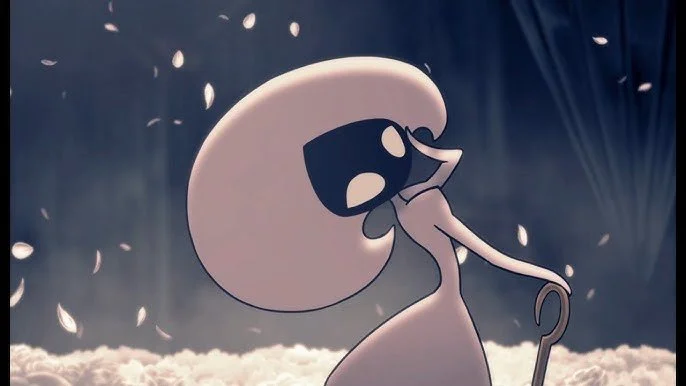
Silksong is a game about many things: religion, community, our inner nature, free will. But one of the most prominent themes that stood out to me when playing, one that I’m surprised isn’t talked about more, is motherhood. This is a game of mothers and daughters, and the burdens placed on both.
This write up includes big spoilers for both Hollow Knight games, and generally assumes you are familiar with both games. Also, I’m not a critic or expert or anything, this is just my informal thoughts and observations.
Part 1: Introduction
I can pinpoint the exact moment I realized how important motherhood is to Silksong. It’s an optional conversation in Act 2, when you turn in your meat for the Huntress in Putrified Ducts. We learn that the Huntress wanted meat to distract her frenzied newborns once they hatch. Typically, they would eat her alive, consuming their own mother for strength. Huntress, with shame, wants to find another way. She asks Hornet: “Is that shameful? A mother who would not sacrifice herself for her children to grow sssstttrong? Is it wrong to want? To witnesss their first flight, their first hunt. To see them kill, and grow?” Hornet responds with what might be my favorite line in the game: “Your choice is your own, tall mother. You won’t be judged by me. I’ve seen enough sacrifice. I’ve no love for the act.”
It’s a brief exchange in a quest that some players will never encounter, and yet to me it clicked so much into place. This feels like a key pillar of the game’s themes, this idea that mothers feel an obligation to sacrifice themselves for their children, and Hornet’s rejection of it. It is seen in the main story as well as side content, and it even echoes back to the original Hollow Knight game, with two prominent mothers (Herrah and the Pale Lady) appearing in the Red Memory sequence to offer their own two cents.
This theme makes a lot of sense. Many people have drawn the parallel that if Hollow Knight pulled heavily from Dark Souls, Silksong pulls heavily from Bloodborne. Instead of crushing isolation, empty ruins, and exploring the history of an order of knights, you’re walking around chapels and finding twisted experiments. The combat is also more aggressive and tool reliant, like Bloodborne’s compared to Dark Souls, and Lace’s fight in the Cradle is visually reminiscent of the white flowers in the Hunter’s Dream. So it’s worth mentioning that Bloodborne also has a ton of connections to motherhood, womanhood, menstruation and childbirth. I won’t go into detail about that because it’s not the purpose of this post (and I’ve never played Bloodborne myself), but it’s worth a google if you’re interested. The relevant point is simply that Silksong takes clear visual, narrative, and ludic inspiration from Bloodborne, a game where ideas like the mother wound play a vital thematic role.
Part 2: The mothers
But let’s take a step back and look at the mothers in the game. The most obvious is Grandmother Silk, the primary antagonist and maternal figure of the story. Grand Mother Silk is a higher being and the creator of the Weavers, the race of powerful warriors that Hornet’s mother belonged to. She is therefore Hornet’s grandmother. Maybe that seems obvious, but that meaning behind her name was lost on me until recently! Silk not only created the Weavers, but also created beings entirely out of her silk, Lace and Phantom. Phantom was eventually abandoned, but her love for Lace continues all the way to her death, and the relationship between Lace and Grand Mother Silk is perhaps the most important in the game: Lace frees Hornet at the start of Act 1, likely as an act of rebellion against Silk, and Silk later refuses to let Lace die which creates the apocalypse of Act 3.
This loyalty to her daughter, even when it is not reciprocated, is the exact sort of selfless affection this world seems to expect of mothers, and it’s one that Silk not only leans into, but seems desperate for. She formed the Weavers and, according to the First Sinner, “called us daughters”. She sought out all weaver descendents after they fled Pharloom to try and bring them back to her. When all else failed, she formed “artificial” children out of thin air, and made their forms perpetually childlike. She wanted daughters, she wanted young ones that would never grow old, never leave her. Being a mother wasn’t just the most notable part of her character, it was practically all she cared about. Even her sinister desire for control over all of Pharloom reads less as a typical tyrant and more as a desperate parent. Still evil, but more emotional than calculated. If you really want to read between the lines, you could argue that the reason there is a space in the middle of grandmother in the name “Grand Mother Silk” is because she isn’t just Hornet’s grandmother, she is also the Grand, the almighty, Mother to all. And yet… is she a good mother? Practically everyone she has called a child has ended up feeling abandoned, betrayed. First Sinner calls her a liar, Phantom calls herself discarded. Even Lace, the child she protects to her dying breath, says in the Cradle (when playing the Needolin) “Why her… Mother… See me cut! See me serve! A child, too broken… I will not fade! I will not take! See me, your knight… See me, your daughter…” Despite caring so much about being a parent, none of her children actually feel loved.
Another notable example is Greyroot, who is not necessarily a mother (they appear to be genderless, or at least not given an explicit gender in the game) but is willing to sacrifice anything, including their own life, to facilitate the birth of their child. In a sense, Greyroot’s quest forces the role of mother on Hornet, who can either extricate the child from her body or go on to reach one of the game’s bad endings, in which she too is sacrificed and petrified to birth a new root-like being. It’s clear that the true ending of the game involves Hornet going to Yarnaby to remove the child from her, and I think it’s interesting that not only does Hornet go up against an all powerful mother, and tell another that she “has no love for” maternal sacrifice, she also explicitly rejects the role of motherhood when it’s forced upon her. And rightfully so! Not only should motherhood never be forced on anyone, but this specific case is clearly incredibly perilous for all the people of Pharloom. It is one of the many instances in this game in which mothers giving themselves up for their children is portrayed as an unequivocally bad thing.
A good mother, the game shows us, is present. Active. Not simply a source of power or sustenance, like Huntress’s meat or Grand Mother Silk’s threads, but a guide, leader, and protector. The Bell Beast (referred to as a mother in the hunter’s journal) is joined on her journey around the bellways by her adorable Beastlings. The Moss Mother lives among the smaller beings of Mosshome and attacks Hornet when she begins killing them. Hornet even admires the creature’s tenacity: “Motherhood is an instinct that can push creatures beyond what seems their normal limits. It turns even weaker beasts like these into formidable foes.” Skarrsinger Karmelita (who refers to the Skarr people as her children) is a leader who is so beloved she is practically worshipped, except that unlike the Weavers she is actually present among her people and loves them. She performs for them, guards their land and way of life, and takes pride in them: “…How we hunted… How we sang… My children, I saw you glorious…” These are mothers we are meant to admire, not because they die for their children, but because they live for them.
Part 3: The daughters
So what is left behind in the aftermath of a mother’s sacrifice? Well, in many cases, it’s an orphaned child, left to fend for itself. Just as important as the burden of the mother in this game is the burden of the daughter. Phantom, falling apart and yearning for death in the Exhaust Organ. First Sinner, chained up for countless years in the Slab. These children of Grand Mother Silk were once loved, but once that love left them they were without purpose, without place. If not a daughter, what are they?
If you do not complete Huntress’s quest in Act 2, then her children are still born. The sacrifice does happen, her children consuming her meat and then scurrying off. But that doesn’t mean the home is empty when you return to her. If you bring the quest items to the hut after these events, you’ll find a child left behind. A runt. This runt tells you that it was too small, too weak, to participate in the feast, and it’s now in need of your generosity to survive and grow strong like it’s siblings: “Usss too will grow?… Sharps claws… hard shell… like siblings goness…”. If you play your Needolin for the runt, it sings: “Why so small? Why so weak? To grow… and be… To feed…” The runt would be protected and nurtured to full strength if its mother had lived, but because of the sacrifice Huntress made, it is left all alone without the ability to hunt. True, Hornet can still help this little child, but she seems saddened by the fate of Huntress herself: “It was a common fate that found her. Too common, perhaps…”
The runt is far from the only child who is lost without their mother. When you find the Savage Beastfly in the Chapel of the Beast, it is slamming its head against the wall of the boss arena, and its needolin dialogue includes the line “Ancestor’s echo, rumbling cry!”. When you defeat the Savage Beastfly (good riddance), you find the ancestor it was referring to: a much larger, long dead creature of similar shape behind the wall it was trying to break. This “savage” creature was really just trying to get through to its ancestor.
Think of the daughters in the game that we actually come to know and talk to. I talked about Lace and her cry for Grand Mother Silk to notice her, but another important example is Shakra. When we find her master, peacefully lying dead under a waterfall, the warrior-turned-cartographer says “The fiercest of my tribe, here she lies. I called her master, true, but she was mother just as much, more by far than the bug who bore me.” To Shakra, her true mother is not the one that brought her into the world, but the one that she actually came to know, the one that she actually lived alongside. And while we don’t know the fate of Shakra’s original parents, she does comment on the fact that her master lived as long as she did: “Ended by age… My tribe would call that shame, but I see only strength unbeaten.” Perhaps this is an indictment of the idea that true warriors should fall in battle, but that strikes an interesting parallel to the idea that a mother should give everything for her children. Just like how some think it is cowardly for a warrior to grow old, some (like Huntress) think that perhaps it is selfish for a mother to grow old. Shakra and Hornet clearly disagree.
And of course Hornet disagrees, her situation is very similar to Shakra’s. We see this in detail in what is perhaps the emotional climax of the game.
Part 4: The Red Memory
Hornet was born of a mother’s sacrifice. Herrah, a weaver who fled Pharloom and settled by Hallownest, agrees to help the Pale King seal the Radiance within the Vessel, but only if he gives her a child. This baby, referred to in Hollow Knight as “the gendered child”, grows up to be Hornet. This sacrifice forces Herrah to, in her own words, “lay forever in duty”, comatose until she is killed by the player to help defeat the Radiance once and for all. She seems to have no regrets, saying in Hollow Knight “…Bound… For brood… For child…Fair bargain made…Give all…For her…”. She knew the sacrifice she was making, and is happy to have done it. The result, however, is that Hornet never truly knew her mother, with the White Lady saying of them that “the two were permitted little time together”.
That’s about all we know before Silksong, and many assumed that Herrah wanted a half-wyrm child so that she could possess greater strength than a simple weaver. The Red Memory, however, complicates this theory greatly. Here, we flash back to Herrah’s “little time” with baby Hornet, and the mother spends this brief moment telling her to resist the urge to seek out strength: “…Greater, grander… Weaver, guardian, queen… Those are their desires… not your own. Certainly not mine…” She even seems to want Hornet to break from the Weavers entirely: “ …Only if you resist them, you might see it, another hope… beyond…” In light of this new information, it makes more sense that Herrah wanted a half-wrym child not so that she may be a stronger weaver, but so that she can remove herself from the weaver’s pursuit of power entirely. She wanted a child with agency.
While Herrah might be Hornet’s mother, it’s clear that she was more greatly influenced by (and perhaps named by) Hive Queen Vespa, the wasp-like warrior that gifted her the pin she fights with and taught her to protect herself. Vespa was the one who actually enabled Hornet to grow into a warrior, much like how Shakra grew closer with her master than with her original parents.
That’s not the only mother Hornet knew, however. While she shares no blood relation to the White Lady, the two clearly share a fondness, and she is the only character in the Red Memory that Hornet actually speaks to. When the White Lady says that she must seem “uncaring, unrepentant” for her role in the sealing of the Radiance, for her birthing of countless offspring, doomed to be either discarded or used as a tool, Hornet instead shows empathy: “You are wrong, Lady… I knew the wish, and the price to achieve it. And now, across these many ages, I have only come to know it better… Strength… in mind, in care, in claw. Strength enough that I may live to see a world better than our own, or to craft a world as I desire. That was the wish, of my mother, of my mentor, and of you…”
I find it interesting that the mother Hornet says this to is the mother that has outlived all of her children. She clearly understands and accepts the cost that was paid by so many in order to combat the Radiance, but it’s not entirely clear if she agrees with it. When faced with the notion of making a sacrifice like her mother’s in order to take on the void, she refuses, telling Lace that “My own life, I shall not sacrifice” and that “the void below all things, that darkness I will fear no longer…” What is clear, however, is that she sees strength as something greater than physical power. She describes strength “in mind, in care, in claw”, a far more nuanced view of it than the Huntress’s runt, abandoned and alone, who sees strength as nothing but “sharp claws” and “hard shell”. Despite her original nature as a power hungry weaver, she has been taught to value compassion. A lesson that cannot be taught to the runt, or Lace, or any of the children who are left without guidance and care. It is through this compassion that Hornet is able to actually save Pharloom.
Part 5: Conclusion
It is no coincidence that so many of these characters are women. Hornet is, after all, the “gendered child”. I think it would be a mistake to simply see this as a commentary on sacrifice, or parenting, or nature vs nurture. There is a distinctly feminine throughline to this entire game, and many characters with an explicit mother/daughter relationship (I haven’t even talked about the Broodmother or the Forge Daughter). Fatherhood, on the other hand, is almost entirely vacant: the Pale King seems intentionally absent from the Red Memory, and the Father of the Flame, perhaps the only character with an explicitly masculine title in their name, is not a character at all but an inanimate totem, a propped up, immobile husk used for worship.
So why? Why fill this game with mothers and daughters, some good some evil, some living some dead? What makes motherhood thematically distinct from other types of parenting?
Obviously I’m just some guy, and by no means do I think I’m an expert on motherhood. But I do think the game powerfully portrays the void that a lost mother leaves behind, and seems fixated on the physical toll that motherhood exacts. The mothers in this game perish for their children, willingly or not, and in some cases wind up betrayed by them. There’s a clear parallel between situations like the Huntress or Cursed Ending and the real life dangers of childbirth. Child bearers can, and do, die to bring children into this world. This is a sad reality, and it’s not one that Hornet denies, nor should we. The point, I think, is that it should not be idealized. By putting too much value on a mother’s willingness to harm themselves, we create a social expectation that is not virtuous at all. It warps our perception of motherhood into something not about nurturing but about martyrdom, it grades a woman’s parenting on a scale of self-destruction.
Not only does this harm mothers such as Huntress, who feel obligated to sacrifice their lives when they don’t want to, but it harms the daughters left behind. Some go out and find guidance elsewhere, such as Hornet or Shakra, while some are left without protection or care, such as the runt or Phantom. The Savage Beastfly bangs its head against a wall trying and failing to reach its elder, just like how Lace wanders the citadel, laughing and fighting in an attempt to gain the notice of her all powerful mother. While Hornet carries with her the identities of the wyrms, the weavers, the people of Hallownest, the warriors of the Hive, Lace is lost with no connections or communities to anchor herself to. The result is that she sees herself as hardly alive at all, since she is simply a being woven of thread: “This weak, wasting existence. This was not life, just a husk shaped to act as a child.” She sees herself as, quite literally, a marionette being controlled by dangling strings. Hornet pushes back, telling her that “Yours was life”.
And Lace truly is alive. She is not like the Father of the Flame, a creation that exists to have meaning extracted from it without any freedom to live on its own. Perhaps that’s what Silk wanted for Lace, but it certainly didn’t turn out that way. As was always the case for Grand Mother Silk, her creation grew to rebel against her and find a path for itself.
If the burden of the mother is an expectation of sacrifice, then the burden of the daughter is an expectation of compliance. They are expected to be one thing, and one thing only: the runt must grow to sharpen its claws, Lace must remain a subservient child. The Broodmother’s children are born into the role of jailer and never stray from it. The First Sinner is literally chained up for breaking from what it is told. The daughters that come to actually find themselves are the ones that grow away from their mother into something larger than the role of a child: Shakra finds her tribe of warriors, Hornet leaves the weavers behind. This is what Herrah wanted for her, she wanted Hornet to grow into something different, something new, like Herrah had done when she broke away from Grand Mother Silk.
Hollow Knight: Silksong is a game about breaking the cycle of female subjugation. In this harsh world full of suffering, mothers are expected to be ever-suffering while daughters are expected to be ever-loyal, both locked in stasis and incapable of growth. Even Grand Mother Silk, the villain of the game, is literally trapped by her children when the Weavers enclose her in a cocoon. The one who breaks this cycle, really, is Herrah. She births a child of two worlds and beckons her to find a new life for herself. Hornet does so: she becomes loyal not to a single person but to people, communities, ideals. She learns from and trains with many people, and then gives her help freely to all who need it. Through this she learns deeper truths about herself, the role of compassion in strength, and the value of a life. She bemoans the sacrifices of mothers, seeing the suffering it creates and the lost souls it leaves behind. And only because of this is she able to understand Pharloom, uncover its secrets, and save it from the void. Think of how much more we can accomplish with mothers who actively help their children find themselves, mothers more like the Bell Beast and less like Grand Mother Silk. When the Huntress lives to Act 3 and actually lives alongside her children, the runt is allowed to know more than base impulses, allowed to think of more than just survival.
Fun fact: there is only one line in the game, as far as I can tell, in which Hornet explicitly refers to herself as a daughter. Given how defined she is by her ancestry, it’s surprising that she only uses the word once, even when talking about her past or her Weaver blood. What is the context in which she uses the word? She does not use it to call herself a Weaver, or a Wyrm, or to connect herself to Herrah, the White Lady, the Hive, or any other influential figure in her life. She tells Lace, right before the final boss, that she is “a daughter of Hallownest”. A product not of a single sacrifice, but an entire people. She is, like all mothers and daughters, greater than one bond.
